
Lake County's Most Wanted Program
The Lake County Sheriff's Office publishes no most-wanted program, no Crime Stoppers partnership, and no active-warrant roster on its public pages. There is no tip line, reward schedule, or update cadence to describe, and Leadville posts no most-wanted roster either. So this page makes no claim that Lake County runs a program it does not have. If the sheriff or the city launches one later, the right approach is to describe its purpose and link straight to the government page. Names, photos, and mugshots belong on the official channel that published them. An official list can change quickly after an arrest, a surrender, or a recall, so a copy elsewhere goes stale fast. Treat the sheriff's own page as the only current word.
No Official Lake County Roster Located
The missing roster is not a gap for a people-search site to fill. The sheriff's public site covers agency, records, detention, patrol, and administration information, but no Lake County most wanted list appears there. The Colorado Judicial Branch docket is a hearing calendar. It is not a warrant roster.
Quick answer: Neither Lake County nor Leadville publishes a most-wanted roster, so there is no local list to reproduce or summarize.
The official Lake County Sheriff page is the right place for the agency's current services and contacts.
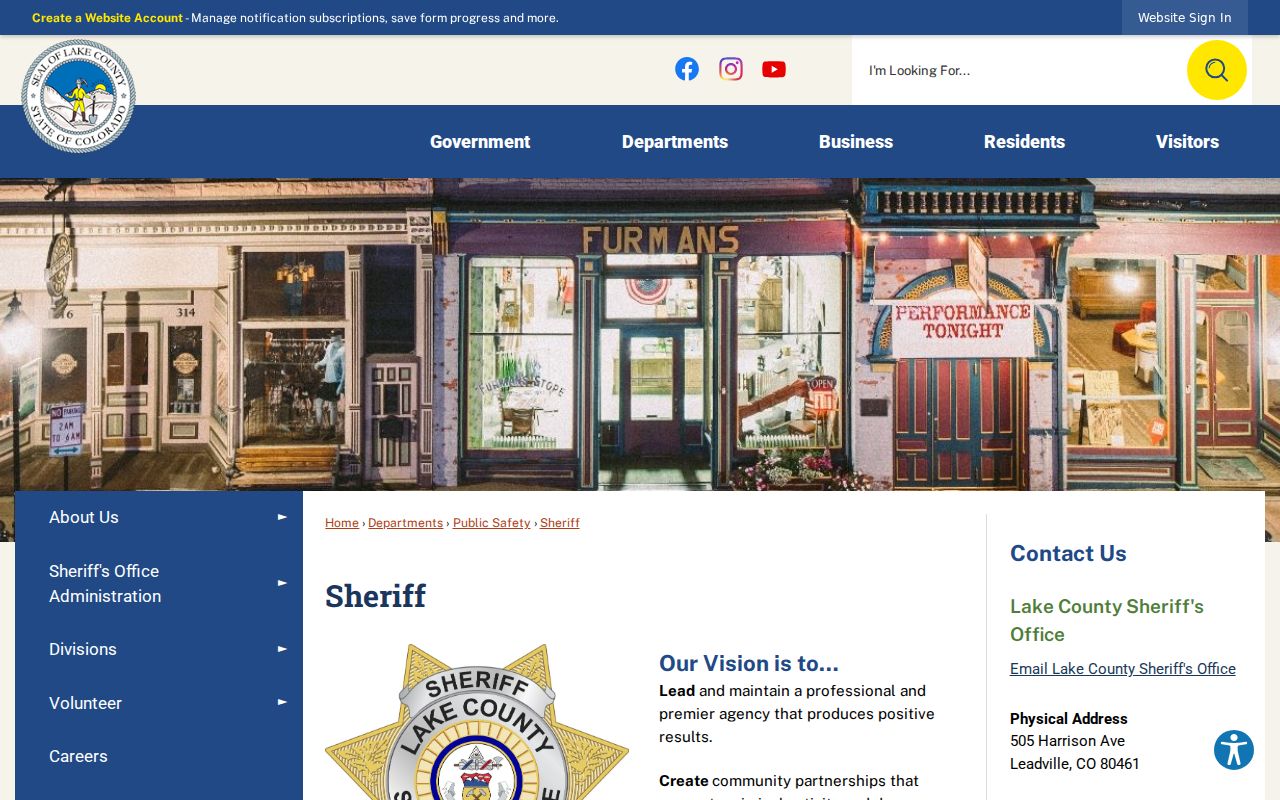
The sheriff's own page remains the public route to agency information. Any future list link should come from the publishing agency itself, and the Lake County page carries no name, photo, or wanted-person roster.
How the Most Wanted Lists Work
A most-wanted list and a warrant search are different things. A most-wanted program picks a few priority cases for public notice and adds safety or tip instructions. A full active-warrant search, by contrast, would cover an agency's broader warrant inventory and state its scope, fields, exclusions, and update time. Lake County offers neither one on its official pages. With no local program published, there is no selection rule, removal process, or update schedule to report. A person can drop off a legitimate list after an arrest, a voluntary surrender, or a court recall, but those are general events, not Lake County policy. Current warrant status still has to come from the issuing court or the law-enforcement office holding the record.
Note: Lake County's public docket is not a warrant database, and a missing docket result does not prove that no warrant exists.
Lake County Warrant Confirmation Chain
Even without a Lake County most-wanted page, you have official routes. Start with the source of the underlying case. Keep the court, the city, and enforcement roles separate.
- Use the Lake County Docket Search to locate a known state case and any hearing label, including a possible “Appearance on Arrest Warrant” event. Treat it as a lead, not live warrant confirmation.
- Call the Lake County Combined Court Clerk at (719) 293-8100 ext. 9 about a state district or county court case. Provide the case number, ticket number, full legal name, date of birth, and known setting.
- Call the Leadville Municipal Court Clerk at (719) 656-0637 for a city ordinance or municipal citation matter. A city warrant may not appear in the state docket.
- Call the Lake County Sheriff's published general communications number at (719) 486-1249 for sheriff-held execution or service questions, or Detention at (719) 486-4185 for custody questions.
- Use a court, sheriff, or city police records request when a specific document is needed. Sealed, suppressed, juvenile, protected, or active-investigation material may be limited.
The official Lake County Docket Search is the public starting point for state hearing information. Pair it with a call to the clerk when warrant status matters.
Reporting a Tip Safely
Lake County has no Crime Stoppers tip channel, no most-wanted reporting line, and no reward program. Never trust an unofficial form or a promised reward. For an emergency, call 911. For non-emergency tips for the Lake County Sheriff's Office, use the agency's published number and follow its instructions.
- Identify the official agency connected to the information. Lake County Sheriff's general communications number is (719) 486-1249, while Leadville Police lists (719) 486-1365.
- State that you have information to report and ask for the proper officer or process. Do not assume the call is anonymous if the agency has not said so.
- Give observations and location details accurately. Do not approach, follow, confront, or attempt to detain anyone.
- For urgent danger, end the non-emergency process and use 911. Follow the dispatcher's directions and keep a safe distance.
Key point: Lake County sources do not promise anonymous tips or rewards, so use official contacts and never confront a person yourself.
Lake County Warrants Beyond Public Rosters
The Colorado Crime Information Center and the National Crime Information Center are criminal-justice systems, not public most-wanted lookups. Their existence does not create a statewide Colorado warrant search for the public. You cannot use CCIC or NCIC in place of calling the Lake County Combined Court, Leadville Municipal Court, or the sheriff.
CCIC: Colorado's criminal-justice information system, available for authorized agency use rather than open public roster searches.
NCIC: A national criminal-justice information system, also not a public self-service warrant portal.
Docket Search: A public court calendar and hearing interface that may show warrant-related hearing text but not a full live warrant inventory.
This is why a blank web search clears no one. Different systems hold different slices of information in Lake County, and some records stay restricted from public view.
Most Wanted Lists vs Active Warrants
Most active warrants would never appear on a curated most-wanted list. A published entry is a selected notice at one point in time. It is not a permanent legal status. Lake County offers neither a full active-warrant search nor a local most-wanted roster, so confirmation has to follow the underlying record.
| Feature | Most Wanted List | Active Warrant |
|---|---|---|
| Scope | Selected public notices in a program | A court command that remains legally active |
| Lake County public product | Not located | No complete public search located |
| Best official source | Future named sheriff or public-safety program page, if published | Issuing court and law-enforcement custodian |
| Meaning of absence | Not proof that no warrant exists | Not established by a blank docket search |
| Resolution | Never determined by deleting copied web content | Controlled by court action, surrender, arrest, bond, or recall as applicable |
The distinction protects accuracy. Publicity is not the warrant itself, and removing publicity does not change a Lake County court order.
Lake County Clearance Event Is Not a Roster
The 5th Judicial District has run a Clear Your Warrant Event, and one session was set for September 19, 2026 at Summit County Combined Courts in Breckenridge. It covered eligible active warrants from Lake, Eagle, Clear Creek, and Summit counties. The pitch was simple: a safe, supportive setting to resolve qualifying matters without arrest. That is a resolution opportunity, not a Lake County most-wanted publication, and not a sign of any standing amnesty policy. The 5th Judicial District announcement lays out the event without naming a single participant. What qualified? Low-level nonviolent misdemeanors, traffic matters, certain lower-level felony property or drug cases, and probation violations. Excluded were many felonies, weapons offenses, Victim Rights Act cases, domestic violence matters, and repeat DUI or DWAI offenses. Questions on eligibility went to warrantforgiveness@da5.us. Treat any future event the same way: read the eligibility rules, follow the official notice, and skip the copied lists. Lake County residents who missed this session should watch for the next district announcement rather than rely on rumor.
If You Think You Are on a List
No official local roster exists here. So a rumor, an old post, a copied image, or a third-party search result is not current Lake County proof of an active warrant. If you are worried about a warrant in your own name, figure out which court may have issued it. Talk to an attorney first. Then get current instructions before walking into a courthouse, sheriff's office, jail, or police station.
Important: Contact an attorney and the issuing court before appearing; ask about status, bond, recall, and a safe voluntary resolution process.
Start with the right office. For state matters, begin with Lake County Combined Court. For a Leadville ordinance or city citation, begin with the municipal clerk. If your concern is custody or how the sheriff executes warrants, use the Sheriff's general or Detention contact. The Lake County outstanding warrants page explains the gap between an active warrant and the public lists that simply are not available here.
Responsible Lake County Program Links
A sound program page names the publishing agency, states the list's scope, shows an update date, gives safety instructions, and lists the official tip channel along with any terms for anonymity or rewards. Those program-level facts can be described. Person-level entries belong on the official Lake County source alone, so updates happen in one accountable place.
| Publisher | The named government or authorized public-safety agency responsible for the page. |
|---|---|
| Scope | The warrant types or jurisdiction the program says it covers. |
| Update Information | The date or cadence stated by the publisher, without inventing one. |
| Safety Direction | The official contact route and any instruction not to approach. |
| Identity Content | Linked only on the official source, never copied, scraped, or republished here. |
That describe-and-link rule holds even if Lake County later publishes an official roster. It keeps stale copies from living on after the issuing agency changes the record.